Sweeping and mopping are two of the most practiced cleaning tasks in any home. They are also among the most commonly done wrong. Floors that look marginally better after mopping than before, streak patterns that persist week after week, and corners that stay dirtier than the open floor regardless of how often they are addressed are not signs of insufficient effort. They are signs of technique problems.
Knowing how to sweep the floor correctly, and how to mop each surface type without causing damage or leaving residue, changes the result every time. This guide covers the six most common errors and the step-by-step technique that actually works.
Quick answer: the right sequence for sweeping and mopping
- Remove loose items from the floor (chairs, rugs, mats)
- Sweep or vacuum the full floor, including under furniture and along baseboards
- Change mop water and prepare the correct cleaning solution for the floor type
- Mop from the far end of the room toward the door, overlapping each stroke
- Allow the floor to dry completely before replacing items or walking on it
Never mop before sweeping. Wet debris becomes sludge, adheres to the floor, and is harder to remove than dry debris.
Why floor cleaning technique matters more than frequency
Professional cleaners consistently observe that floors in homes cleaned frequently still accumulate visible grime in corners, along baseboards, and under furniture edges. The cause is technique, not frequency.
Random multi-direction strokes move debris around the surface without collecting it. Mopping with a dirty or over-wet mop head spreads bacteria and residue across the floor, producing a dull, slightly sticky result. Cleaning in the wrong sequence means the floor is never actually clean at any point during the session.
Correcting technique produces noticeably better results immediately, without any increase in time or effort.
Choosing the right tools
The equipment matters before technique can work correctly.
For sweeping:
A broom with fine, soft bristles is the right choice for interior hard floors. Stiff outdoor brooms scatter fine dust and debris rather than collecting it.
A microfiber dust mop with an electrostatic charge covers more area efficiently and traps fine particles rather than pushing them into the air. This is particularly useful in homes with significant allergen concerns, since a standard broom becomes a debris-scattering tool for particles small enough to stay airborne.
The dustpan edge is critical. A flexible rubber or plastic edge that sits fully flush with the floor prevents the persistent line of fine debris that remains after sweeping into a rigid pan. If the dustpan edge does not make full contact with the floor, some debris will always remain.
For mopping:
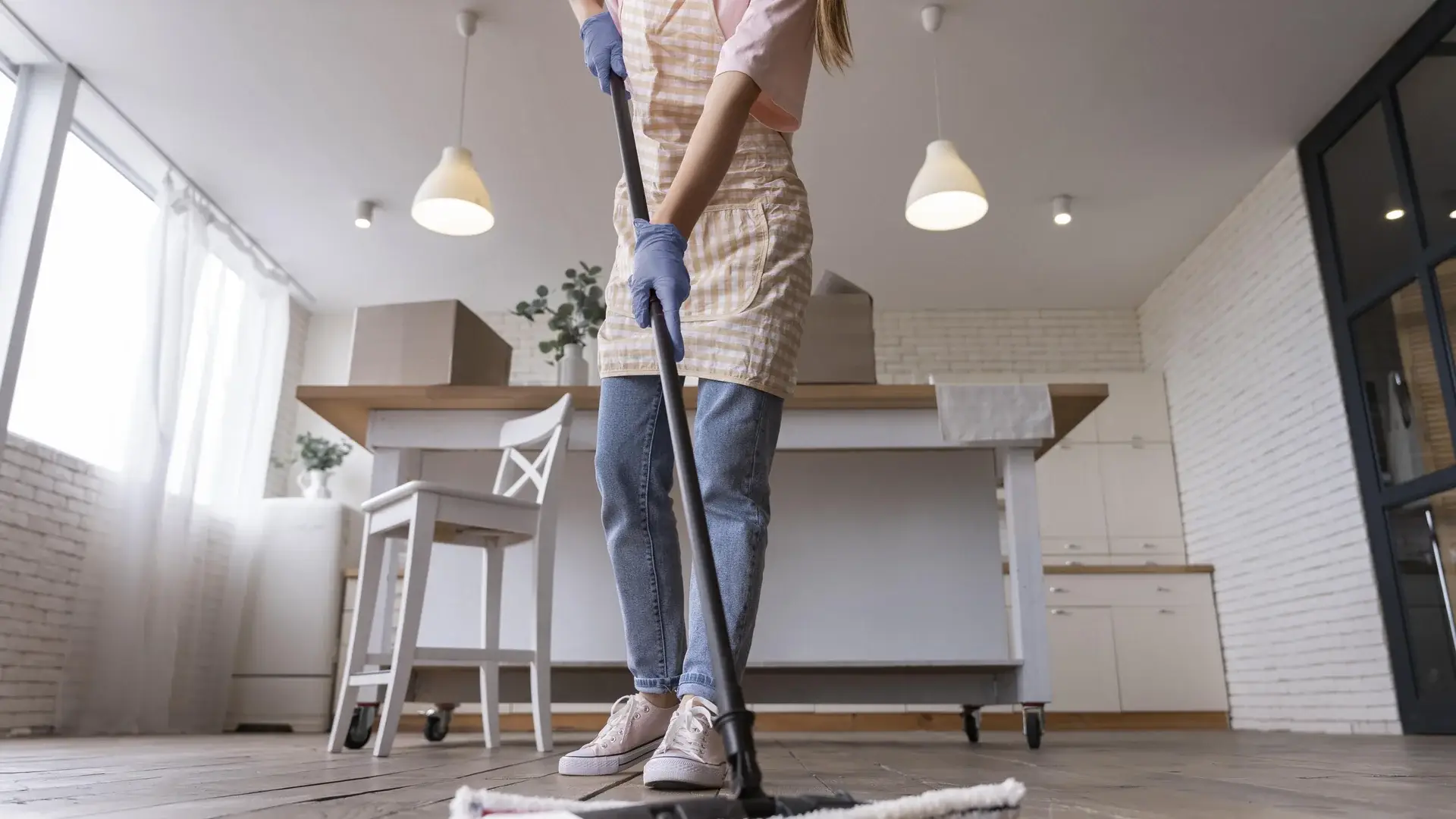
A flat-head microfiber mop is the correct tool for hardwood, engineered hardwood, laminate, and luxury vinyl. These surfaces are damaged by the volume of water a string mop deposits. Microfiber applies a controlled, minimal amount of moisture that dries within one to two minutes.
A traditional string mop or sponge mop is appropriate for ceramic tile, porcelain tile, and concrete, which tolerate and benefit from more moisture during cleaning.
Do not use the same mop on hardwood and tile floors. Even a washed string mop retains residual moisture that damages wood floor finishes over repeated use.
6 floor sweeping and mopping mistakes that leave dirt behind
Mistake 1: Sweeping in multiple random directions
Multiple short strokes in different directions move debris around without systematically collecting it. Fine particles scatter into the air and resettle. Larger debris migrates without reaching the dustpan.
The fix: Use long, overlapping strokes from one end of the room toward you, moving systematically across the room’s width. Each stroke overlaps the previous by a few inches. This herds all debris in one direction toward a single collection point, from which it can be swept into the dustpan cleanly.
Mistake 2: Skipping under furniture and along baseboards
These areas accumulate the most debris and are the most commonly skipped. Corners where two walls meet, the gap between floor and baseboard, and the space under low furniture are the primary reservoirs from which foot traffic and air circulation redistribute debris back across the cleaned floor.
The fix: Address baseboards and corners first, before sweeping the open floor. Angle the broom to sweep along the baseboard channel. Use a microfiber dust mop with a low-profile head for areas under furniture that a standard broom cannot reach.
Mistake 3: Mopping before sweeping the floor
Mopping a surface that has not been swept turns dry debris into wet sludge. Larger particles pushed by the mop head distribute wet debris across the full floor. Fine dust saturated by the mopping solution adheres to the floor as it dries, producing a grimy finish.
The fix: Always sweep or vacuum completely before introducing any moisture. Sweeping and mopping are sequential steps. The sequence cannot be reversed.
Mistake 4: Using too much water
Excess moisture is the primary cause of hardwood and laminate floor damage. These materials expand when they absorb moisture. Repeated over-wetting causes cupping, warping, and joint separation over time. It also causes hardwood floor finishes to cloud and degrade faster.
The fix: The mop head should be wrung until it feels barely damp. Pressed to your forearm, it should leave almost no moisture. The floor should dry within one to two minutes of mopping. If it takes longer, the mop is too wet.
Mistake 5: Mopping with a dirty mop head
A mop head that has not been washed since the last session carries bacteria from the previous floor and residue from the previous cleaning solution. Research published in the American Journal of Infection Control found significant gram-negative bacterial contamination in commercial mop heads after a single cleaning session. The same applies to household mops.
The fix: Wash microfiber mop pads in the washing machine after every use, without fabric softener. Fabric softener coats microfiber and significantly reduces its cleaning effectiveness. Air dry or tumble dry on low. Replace mop heads on schedule: microfiber pads every three to six months, string mop heads every one to two months.
Mistake 6: Mopping toward the center or in random directions
Mopping in random directions means walking on sections already cleaned, redepositing dirty solution from shoe soles, and redistributing debris from un-mopped areas into mopped areas.
The fix: Mop yourself out of the room. Start at the far corner or far wall and work in overlapping strokes toward the door. On large floors, divide into sections and mop each section completely before advancing, always backing toward the exit of that section.
The right cleaning solution for each floor type
Using the wrong solution on a floor type damages the surface and can void manufacturer warranties.
| Floor type | Correct solution | What to avoid |
|---|---|---|
| Hardwood (natural) | A few drops of dish soap per gallon of warm water, or a dedicated hardwood cleaner | Vinegar, bleach, oil soap, steam |
| Engineered hardwood | Same as natural hardwood, minimal moisture | Any excess moisture |
| Laminate | Warm water with a small amount of dish soap, barely damp mop | Vinegar, steam, excess water |
| Ceramic or porcelain tile | Warm water with all-purpose cleaner or diluted white vinegar | Acidic cleaners on unsealed grout |
| Natural stone | pH-neutral cleaner labeled safe for stone | Vinegar or any acidic cleaner |
| Vinyl and LVP | Warm water with a small amount of dish soap | Abrasive cleaners, steam |
The Hardwood Floor Manufacturers Association recommends using a well-wrung damp mop rather than a wet mop on all wood flooring, and using only cleaners specifically designed for the finish type. Manufacturer guidance for the specific floor product should be consulted when available.
Cleaning frequency by area
| Area | Sweep or vacuum | Mop |
|---|---|---|
| Kitchen | Daily | Every 2 to 3 days |
| Bathrooms | Every other day | Twice a week |
| Entryways and hallways | Daily | Weekly |
| Bedrooms | Twice a week | Every 1 to 2 weeks |
| Living areas | Twice a week | Weekly |
Households with pets, young children, or significant outdoor foot traffic need the more frequent end of these ranges throughout the home.
Signs your floor cleaning routine needs a reset
Professional cleaners identify these as reliable indicators that a floor cleaning routine has developed technique gaps:
- Floors feel slightly sticky after mopping despite using the correct product
- The area under furniture is noticeably darker than the open floor area
- Baseboards have a visible dark line of compressed debris at floor level
- Grout lines between tiles are significantly darker than the tile surface
- Floors need cleaning again within one to two days of the last session
Any of these signals means the current routine is leaving residue or missing areas that accumulate faster than the visible floor surface. The six mistakes above are the most common cause of each symptom.
Frequently asked questions
Why does my hardwood floor look dull after mopping? Dullness after mopping typically means too much water was used, leaving a residue film as it evaporates, or the cleaning product is leaving its own residue. Try mopping with plain distilled water using a well-wrung flat mop. If the floor brightens, switch to a residue-free hardwood cleaner. If dullness persists, the finish may have degraded and need refinishing.
Should I sweep or vacuum before mopping? Either works for removing debris before mopping. Vacuuming with a hard floor head is generally more effective than sweeping for fine dust and pet hair, particularly in corners and along baseboards. If allergen dust is a concern, vacuuming before mopping captures particles that sweeping would scatter into the air.
Can I use a steam mop on all floor types? No. Steam mops are appropriate for ceramic tile, porcelain, and some vinyl floors. They damage hardwood, engineered wood, laminate, and most natural stone. Always check the floor manufacturer’s guidelines before using a steam mop.
How do I clean between tile grout lines? Standard mopping does not clean grout. Grout requires a stiff-bristle grout brush applied along the line with an appropriate cleaner. Do this monthly to prevent grout discoloration from setting.
Consistent floors with less effort
Correcting the six mistakes covered in this guide changes floor cleaning results immediately. Long overlapping strokes with the right broom type, baseboards first, dry sweep before any moisture, a barely damp mop for wood surfaces, a clean mop head, and direction always toward the door.
These adjustments require no additional time. They just require doing the familiar task correctly.
For homes where floor maintenance is part of a broader cleaning routine, a regular cleaning service covers every floor type with the right technique and products on a schedule matched to the household. When floors need a more comprehensive treatment, including grout scrubbing and baseboard attention, a deep cleaning service provides the thorough reset that routine mopping cannot reach.
Keep Reading
Rather hand the work to a team that does this every day? See our deep cleaning service or call (214) 430-4447 for a free quote.
Want Your Home to Look Like This Without the Work?
Tell us about your place and we will send you a price. No walkthrough required, no obligation.
- Free quote with no obligation
- Non toxic and pet friendly products
- Bonded and insured, serving DFW since 2002
- 24 hour guarantee on our service
Prefer to talk? (214) 430-4447
By completing this form I acknowledge that I will receive informational text messages from E&R Cleaning Services. I can opt out at any time by replying STOP. Standard message rates may apply.