Most people clean the bathroom when it starts to look dirty. The problem: by the time a bathroom looks dirty, the bacterial load, mold growth, and surface buildup are already well established. Visible grime is a lagging indicator.
Knowing how often should you clean your bathroom, surface by surface, is a more useful question than asking how often to clean the bathroom in general. The toilet bowl develops a visible bacterial ring within days. The exhaust fan may only need attention every two months. Treating both with the same interval wastes time on one and neglects the other.
Quick answer: bathroom cleaning frequency by surface
| Surface | Recommended frequency |
|---|---|
| Toilet bowl | Twice a week |
| Toilet exterior | Once a week |
| Shower walls and door | After each use (squeegee) + weekly scrub |
| Shower grout | Monthly |
| Bathroom sink basin | Twice a week |
| Faucet handles | Daily |
| Bathroom mirror | Once a week |
| Floor (sweep) | Every other day |
| Floor (mop) | Once a week |
| Shower curtain or liner | Monthly |
| Exhaust fan | Every 2 to 3 months |
| Towels | Every 2 to 3 uses |
Why surface-specific frequency matters
Different surfaces in the bathroom deteriorate at dramatically different rates. A consistent but undifferentiated once-a-week clean misses the high-urgency surfaces and wastes effort on surfaces that hold up fine for longer.
A surface-specific approach produces better hygiene outcomes with the same or less total time per week. The key is knowing what each surface actually needs and why.
Toilet bowl: twice a week
The toilet bowl is a warm, moist, mineral-rich environment where bacteria establish themselves quickly. E. coli, Staphylococcus, and other organisms from fecal matter form the visible ring inside the bowl within three to four days of a last clean under typical household use.
Toilet plume, the aerosol created each time the toilet is flushed, disperses bacteria up to six feet from the bowl. Research published in the American Journal of Infection Control documented the distribution of these particles across bathroom surfaces. The CDC recommends closing the toilet lid before flushing to significantly reduce this dispersal.
What to do: Apply a disinfectant toilet bowl cleaner, scrub with a toilet brush under the rim and across the full inner surface, then flush. Twice a week is the minimum for a bathroom used by two or more people.
Toilet exterior: once a week
The tank, seat, lid, hinges, and base accumulate skin cells, dust, and toilet plume-dispersed bacteria continuously. The floor joint at the base, where the toilet meets the tile, collects cleaning solution residue and organic debris and is easy to overlook.
Wipe all exterior surfaces with a disinfecting cloth or a cloth dampened with diluted all-purpose cleaner once a week. Pay specific attention to the hinge hardware and the floor line around the base.
Shower walls and door: squeegee after each use, full scrub weekly
This is the cleaning habit with the highest return on investment in any bathroom. Soap scum is the residue of fatty acids from soap reacting with calcium and magnesium in hard water. In hard water areas like much of North Texas, a visible soap scum layer develops within two to three shower uses.
Soap scum does more than look bad. It provides a surface on which mold and mildew establish themselves. The pink or orange film that develops in many showers, typically Serratia marcescens bacteria, grows fastest on soap scum-coated surfaces.
After each use: Squeegee shower walls and the glass door immediately after showering. This takes 30 seconds and removes the majority of moisture and soap film before it can deposit. It is the single most effective habit for extending the time between full scrub sessions.
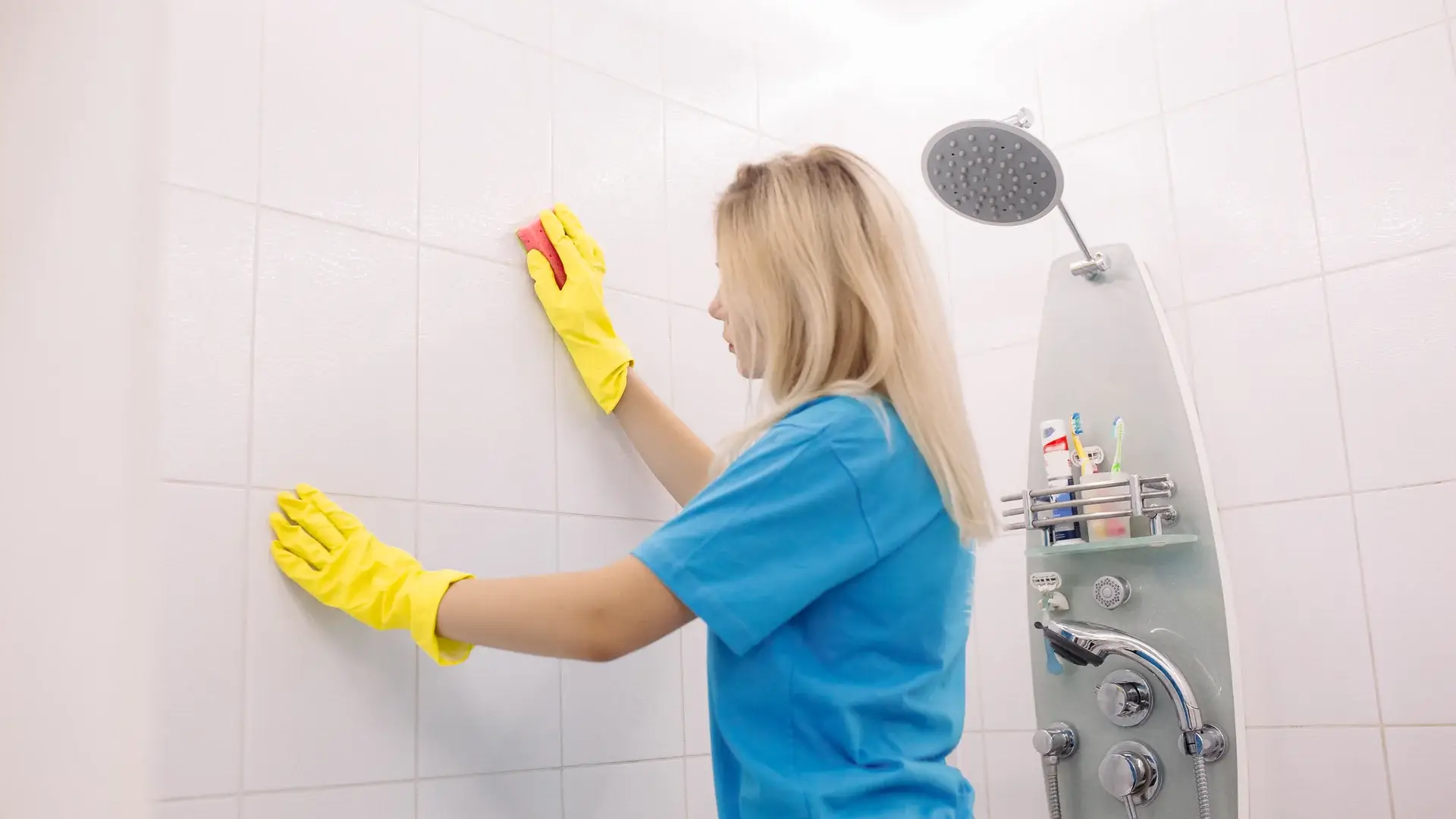
Weekly scrub: Apply a bathroom cleaner to walls, tile, and the door or curtain. Let it sit for five minutes before scrubbing, particularly on grout lines. Rinse thoroughly.
Shower grout: monthly
Grout is porous. It absorbs moisture, soap residue, and mold spores with every shower. The black or pink discoloration that develops in grout lines is established mold or bacterial growth, not surface staining that wipes away.
Scrub grout lines monthly with a stiff-bristle grout brush and an appropriate cleaner. For mold already present, a diluted bleach solution (one part bleach to ten parts water) applied with a grout brush and left for ten minutes before scrubbing is more effective than standard bathroom cleaner. According to the EPA’s mold guidance, non-porous surfaces with mold can be cleaned with detergent and water, but grout often requires bleach to address established growth.
Annual grout sealing slows moisture absorption and makes monthly cleaning faster and more effective.
Bathroom sink basin: twice a week
The bathroom sink handles toothpaste, soap, and repeated handwashing throughout the day. The drain area accumulates biofilm faster than most of the basin surface and is the primary source of sink odors.
Scrub the full basin, including the drain surround and the areas under the faucet base, with a bathroom cleaner and a soft brush or cloth twice a week. The area under the faucet spout, where water constantly pools and evaporates, develops mineral deposits and biofilm that a surface wipe does not fully address.
Faucet handles: daily
Faucet handles are touched with unwashed hands every time someone begins washing. In a household of four people, this represents 30 to 50 daily bacterial transfers to the handle surface before a single cleaning occurs.
Wipe faucet handles, the spout base, and the surrounding deck area with a disinfecting cloth daily, or every time the sink is fully cleaned at minimum. This is the highest-contact surface in the bathroom and the one most directly affecting the effectiveness of hand hygiene in the home.
Bathroom mirror: once a week
Toothpaste splatter and moisture spots are the primary mirror issues. A weekly pass with a glass cleaner applied to a microfiber cloth (not sprayed directly onto the mirror, which allows overspray onto surrounding surfaces) keeps mirrors clear with minimal effort.
Wipe in one consistent direction, horizontal or vertical, to avoid redistributing residue across the surface.
Bathroom floor: sweep every other day, mop once a week
The floor directly around the toilet base and in corners accumulates the most debris. Hair, lint, and bathroom debris collect quickly in these areas and become harder to remove once compressed.
Sweep or vacuum every other day. Mop with a disinfecting floor cleaner once a week. Pay specific attention to the toilet base joint and the corners near walls. In households with young children or high bathroom traffic, mop twice a week.
Shower curtain and liner: monthly
Fabric shower curtains develop mildew along the lower edge where they pool water and absorb soap residue. Plastic liners develop the same problem faster, as plastic is more hospitable to mold than fabric.
Machine-wash fabric curtains monthly with laundry detergent and half a cup of white vinegar in the rinse cycle. Most fabric curtains survive a gentle machine wash cycle. Plastic liners can also be machine-washed on gentle with baking soda in the wash cycle. Replace plastic liners every two to three months regardless of cleaning frequency.
Exhaust fan: every 2 to 3 months
The exhaust fan removes humidity from the bathroom after showers. When the grille and fan blades accumulate dust, the fan becomes less effective. A bathroom where the fan runs at reduced efficiency dries more slowly, which accelerates mold growth in grout, caulk, and on tile surfaces.
Remove the grille cover and wipe it with a damp cloth. Vacuum fan blades with a soft brush attachment. This takes about five minutes and should be part of a quarterly maintenance routine.
Towels: every 2 to 3 uses
Towels stay damp after every use and collect shed skin cells continuously. Bacteria multiply in damp fabric at room temperature within hours. Research on towel hygiene has documented bacterial transfer from previously used towels back to freshly washed skin.
Replace bath towels after two to three uses and wash on a warm to hot cycle. Hand towels in bathrooms used frequently should be replaced every one to two days.
Common mistakes that make bathroom cleaning less effective
Professional cleaners consistently see these errors in homes that “always feel dirty” despite regular cleaning:
- Cleaning the sink but not the faucet handles: the handle is the highest-contact surface and is almost always skipped.
- Mopping before sweeping: wet debris is harder to clean than dry debris and gets spread across the floor surface.
- Ignoring the toilet base joint: this gap accumulates bacteria and cleaning residue that re-contaminates the surrounding floor.
- Skipping the overflow drain: the small hole near the top of the sink basin accumulates mold inside its channel and is rarely cleaned.
- Storing a damp sponge in the sink: the NSF International found that the kitchen sponge is the most bacteria-laden item in most homes. Bathroom sponges stored wet develop the same problem.
Adjusting frequency for your household
The frequencies above assume one to two users. Every additional person sharing the bathroom compresses the effective interval. A bathroom shared by four people needs:
- Toilet bowl cleaned three times a week
- Floor swept daily
- Hand towels changed daily
- Faucet handles wiped twice daily
During illness, particularly gastrointestinal or respiratory infection, all surfaces should be disinfected daily, including the door handle, toilet exterior, and faucet handles, until 48 hours after full recovery.
Frequently asked questions
What causes the toilet to smell even after cleaning? The odor source is usually the floor joint at the base of the toilet, the underside of the rim inside the bowl, or the exhaust fan interior. Standard cleaning routines often miss all three. Address each one specifically.
How do I know if my exhaust fan is working properly? Hold a piece of toilet paper near the fan grille while it is running. If it is pulled toward the grille, the fan has adequate suction. If it falls away or hangs limp, the fan needs cleaning or replacement.
Is bleach necessary for bathroom cleaning? Bleach is the most effective agent against established mold in grout and caulk. For routine surface disinfection on the toilet, sink, and floors, EPA-registered bathroom disinfectants are equally effective and easier to use safely.
My bathroom always smells musty despite regular cleaning. What am I missing? Musty odors typically come from the overflow drain, the exhaust fan interior, old caulk with embedded mold, or grout that has not been treated with a bleach solution. Address each of these systematically rather than cleaning the visible surfaces more frequently.
Sustainable bathroom hygiene starts with one habit
If only one habit is added from this guide, make it the squeegee after every shower. This single behavior prevents the majority of soap scum and mold problems before they develop, reduces the intensity of weekly scrub sessions, and keeps glass doors and tile walls visibly cleaner with almost no additional effort.
Understanding how often should you clean your bathroom by surface means no single session is overwhelming. The daily habits are small. The weekly scrub is more effective because the small habits have done their work in between.
For households where consistent bathroom maintenance is difficult to sustain, a regular cleaning service covers bathroom cleaning at the right frequency for each surface. When grout, caulk, and exhaust fans need attention beyond routine upkeep, a deep cleaning service provides the comprehensive treatment those surfaces require.
Keep Reading
Rather hand the work to a team that does this every day? See our deep cleaning service or call (214) 430-4447 for a free quote.