Living with pets is not a cleaning problem to be solved once. It is a set of ongoing systems, and the households that manage it well are not cleaning more than everyone else. They are cleaning in different places, with different tools, on a different rhythm.
Hair Comes Off Differently on Every Surface
This is where most effort gets wasted, because the same tool is used everywhere and it only works on one thing.
On upholstery, a vacuum alone leaves the hair that is woven into the weave. What actually lifts it is friction: a rubber glove dampened slightly and dragged across the fabric, or a rubber pet brush. The hair rolls into clumps you can pick up. It looks primitive and it outperforms every attachment.
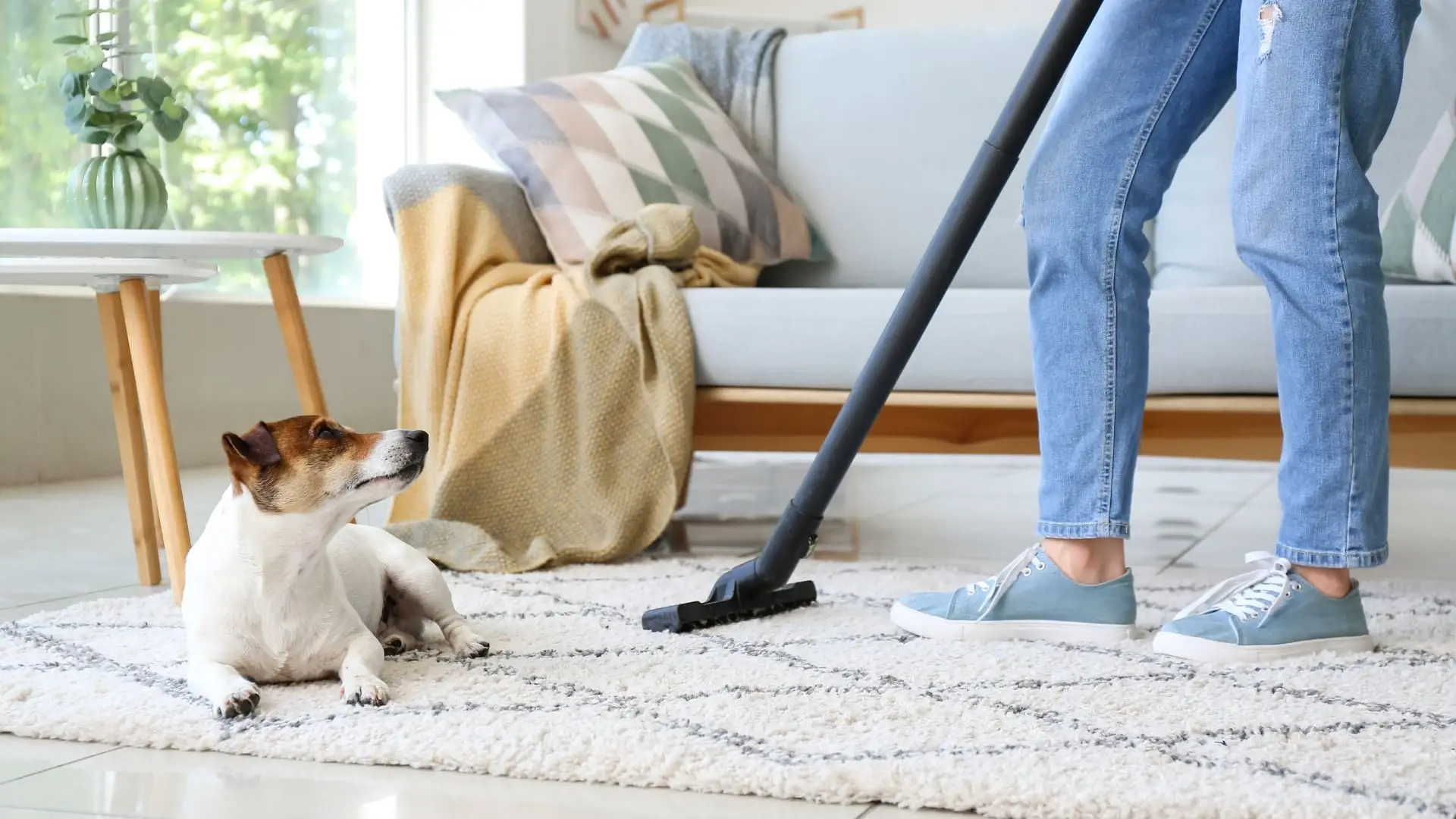
On carpet, hair works down into the base of the pile where suction cannot reach. A rubber broom or a carpet rake pulls it up to the surface first, then you vacuum. Doing it in that order roughly doubles what comes out.
On hard floors, do not vacuum aggressively first, because it launches hair into the air where it drifts to the edges of the room and settles again. A dry microfiber flat mop gathers it into a single pile instead.
On clothing and bedding, a fifteen minute tumble in the dryer on air fluff before washing removes a surprising amount into the lint trap, and it stops hair from redepositing in the wash.
Odor Is Never in the Air
Air fresheners and candles are the reflex and they do nothing except add a second smell on top of the first. Pet odor lives in three places, and it comes out of them or it does not come out at all.
Soft materials that absorbed it, meaning bedding, upholstery, rugs and curtains. The hard floor beneath and around where the animal sleeps. And the animal’s own equipment: the bed, the crate, the collar, the toys, the litter box, the food and water bowls, which develop a biofilm that is genuinely unpleasant and is almost never washed daily.
Wash pet bedding weekly, and wash food and water bowls daily like any other dish.
Enzymes, and Why Everything Else Fails on Accidents
Pet urine is not a normal stain. It is organic, and the uric acid crystals in it are not water soluble, which is why a spot you cleaned six months ago comes back on a humid August afternoon.
An enzyme cleaner is the only category that works, because enzymes break the compounds down rather than diluting them. Use it generously enough to reach as deep as the urine went, which is further than the visible mark, and keep it damp for the time on the label rather than blotting it dry immediately. Then let it air dry.
Do not use an ammonia based cleaner on urine. Ammonia smells like urine to an animal and marks the spot as a place to go again.
And be realistic: if urine reached the carpet pad or the subfloor, surface treatment buys weeks. The real fix is pulling the carpet and pad in that area and sealing the subfloor.
Paws Are the Delivery System
Most of what a dog brings into the house arrives on four feet, and the entire problem is solved at one door.
A towel or a paw cleaner kept at the door people actually use, plus a mat long enough for several steps, removes the majority of it. Keep the fur between the paw pads trimmed, since that is what holds mud and grass seed. In summer, rinse after the pool, because chlorinated water dries on floors as a residue.
Products That Are Not Safe Around Animals
This matters more than most pet owners realize, because animals walk on floors and then lick their paws.
Pine and phenol based cleaners are particularly poor around cats. Concentrated essential oils, tea tree especially, are toxic to cats and dogs. Bleach residue on a floor ends up ingested. And any floor cleaner should be one that dries without leaving a film that paws pick up.
Practically, that means neutral floor cleaners used at the correct dilution, rinsing where a product says to, and keeping animals off a surface until it is genuinely dry rather than just looking dry.
The Air, Which People Forget
Dander is airborne and it settles at the edges of rooms, on fan blades, on the tops of door frames and in the ductwork. Vacuum with genuine HEPA filtration, because a vacuum without it takes fine dander off the floor and puts it back into the room. Change the HVAC filter more often than the label suggests, and brush the animal outside rather than inside.
What a Realistic Rhythm Looks Like
Daily: bowls washed, paws at the door, a quick pass on the animal’s main area. Weekly: pet bedding washed, floors and upholstery done with the right tool. Monthly: the deeper pass on the reservoirs above eye level. And a deep clean two to four times a year, which is what keeps a pet household from smelling like one.
Call (214) 430-4447 or request a free quote online. Tell us how many animals, what kind, and whether there have been accidents, and we will tell you honestly what a clean will resolve and what needs replacing.
Keep Reading
- How to Get Rid of Pet Stains on Carpet
- Pet Dander Left by a Previous Owner
- Cleaning Safely Around Babies and Pets
- Allergen Cleaning in McKinney TX
- What Eco Friendly Labels Actually Mean
Want Your Home to Look Like This Without the Work?
Tell us about your place and we will send you a price. No walkthrough required, no obligation.
- Free quote with no obligation
- Non toxic and pet friendly products
- Bonded and insured, serving DFW since 2002
- 24 hour guarantee on our service
Prefer to talk? (214) 430-4447
By completing this form I acknowledge that I will receive informational text messages from E&R Cleaning Services. I can opt out at any time by replying STOP. Standard message rates may apply.