Most parents have said some version of “please pick up your toys” more times than they can count. The request rarely works on the first try, and by the end of a long day, it often turns into a negotiation nobody wins.
The good news is that kids who resist cleanup almost always do so for the same few reasons. None of those reasons require stricter rules or louder reminders. They require a better pick up toys system.
The real reason the routine works
The fastest way to get kids to consistently pick up toys is to make the system match their age. Keep storage simple enough that putting things away takes less effort than finding a hiding spot. And build cleanup into the daily routine before resistance has a chance to form.
Why kids resist the pick up toys routine
Understanding why cleanup feels hard for kids makes it easier to design a system that actually works.
Young children have limited working memory. Asking them to “clean up” without a specific instruction, like “put the blocks in the red bin,” is genuinely confusing. It is not defiance. It is too vague a request for where a child is developmentally.
Older kids resist when cleanup feels open-ended or when the “before” state (toys everywhere) looks so overwhelming that they do not know where to start. The same paralysis adults feel when facing a cluttered room.
A routine that breaks cleanup into small, concrete steps removes both of those barriers.
7 strategies to make toy cleanup stick
1. Use a cleanup song or timer
A two-minute cleanup song gives kids a clear start and end point. The routine signals that cleanup is happening now, not as a vague future event. When the song ends, the job is done. Many families find a consistent song works better than reminders because the cue comes from the song, not from the parent.
2. Sort storage by type, not by color
Color-coded bins look appealing in photos, but kids clean up faster when bins are labeled or sorted by toy category. Cars in one bin, blocks in another. Decision fatigue slows down even simple tasks for young children. Fewer decisions at cleanup time means less resistance.
3. Reduce the total number of toys in rotation
Toy rotation is one of the most effective playroom organization tips that rarely gets enough attention. When fewer toys are available at once, cleanup is faster and play is often more focused. Store the rest out of sight and swap them in every few weeks.
4. Make the storage reachable
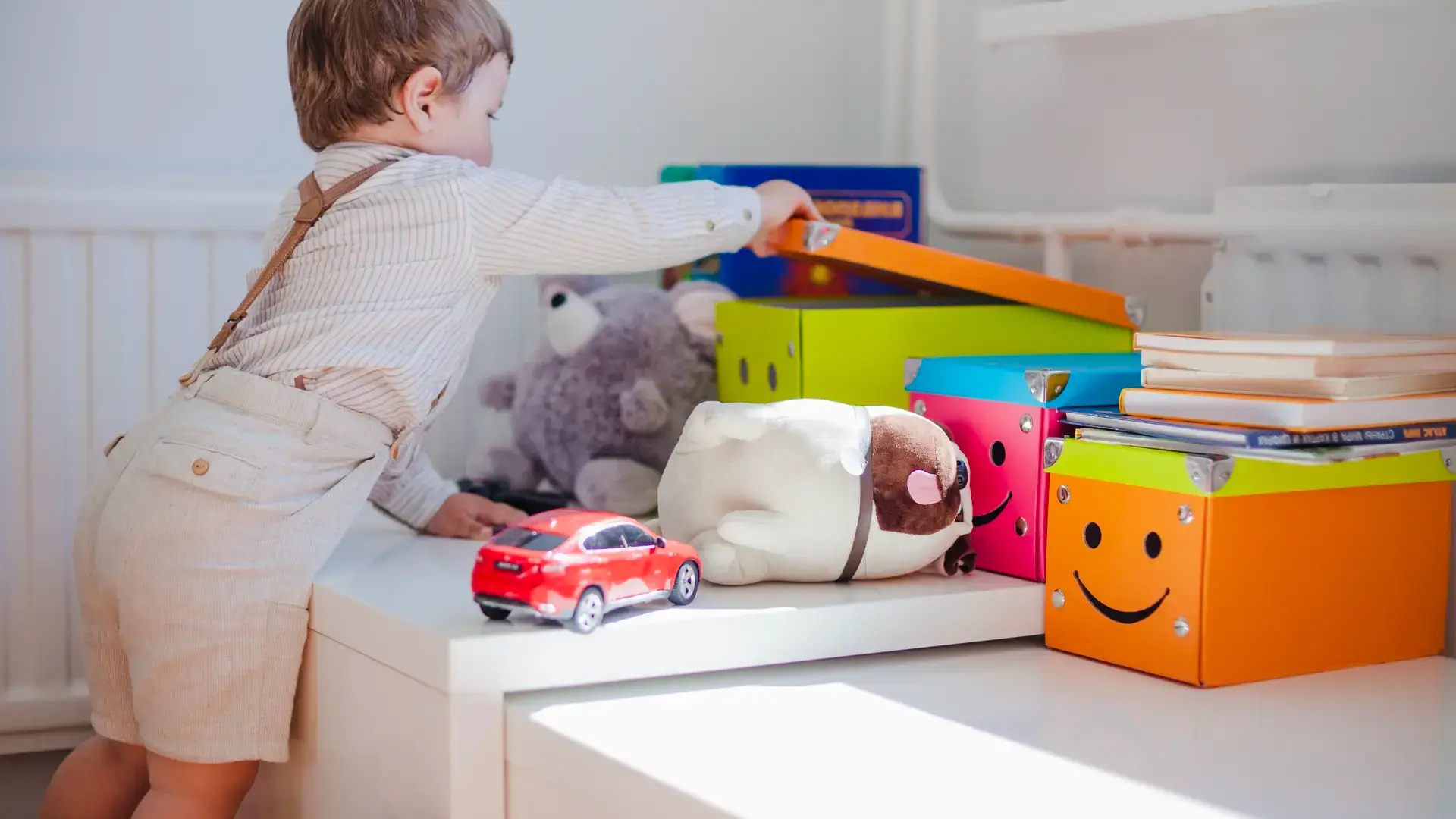
Kids who cannot reach their own storage bins cannot clean up independently. Bins at eye level, hooks they can actually reach, and shelving low enough to use without help are all essential. If cleanup requires an adult to put things away, the routine will never become a child-led habit.
5. Tie cleanup to a natural transition
Cleanup before dinner, before a bath, or before screen time gives kids a clear signal and an obvious reward. The transition itself becomes the routine, not the parent’s voice. “After we clean up the toys, we eat” is much easier for a young child to follow than a standalone cleanup request mid-play.
6. Clean up together first, then hand it off
Parents who sit on the floor and clean up alongside their kids, especially when introducing a new routine, see much faster adoption. Children learn cleanup as a shared activity before they are expected to do it alone. Gradually stepping back over a few weeks hands the routine over without a fight.
7. Avoid using cleanup as a punishment
When picking up toys becomes the consequence for bad behavior, kids learn to associate it with something negative. Cleanup should feel neutral or even positive, a transition activity, not a penalty. That framing makes the daily routine easier to accept over time.
Age-by-age expectations for toy cleanup
Matching expectations to a child’s actual developmental stage prevents a lot of frustration on both sides.
Ages 2 to 3: Can put one or two items away with direct guidance. “Put the bear in the basket” is appropriate. Independent cleanup is not realistic at this age.
Ages 4 to 5: Can follow a two-step instruction and handle simple sorting. They still need a defined space and simple bins.
Ages 6 to 8: Can manage a full cleanup routine with minimal prompting once the habit is established. This is the window where consistency pays off most.
Ages 9 and up: Can take ownership of a space, including putting away storage bins, organizing shelves, and noticing when things are out of place without being told.
Playroom organization tips that make cleanup faster
The physical setup of a playroom matters as much as any verbal routine. A few layout changes make a big difference.
- Keep the most-used toys at the lowest, most accessible level
- Use bins that are easy to see into, so children can identify where things go
- Limit the number of storage categories to five or fewer for young children
- Put a small basket near the door of each room for toys that drift away from the playroom
Cleanup becomes easier when returning a toy to its home is visually obvious. When children have to guess where something goes, they often leave it on the floor instead.
Common mistakes that make toy cleanup harder
- Saying “clean up your room” instead of naming the specific task
- Expecting a full cleanup right after school or when the child is hungry or tired
- Reorganizing storage frequently, which resets any routine the child has learned
- Using cleanup as the one consistent rule in an otherwise inconsistent household, which creates more resistance, not less
Professional organizers who work in family homes consistently point out that the cleanup problem is almost never about the child’s willingness. It is about whether the environment makes the right behavior easier than the wrong one.
How this connects to a cleaner home overall
A toy pickup routine is one piece of a broader home cleaning rhythm. When kids handle their own spaces, parents spend less time on reactive cleanup after bedtime. That shifts the household toward maintenance cleaning rather than constant catch-up.
For families who want that rhythm to extend to the whole home, a regular cleaning service from E&R Cleaning Services keeps floors, kitchens, and bathrooms consistently reset between visits. That makes the daily toy pickup routine the only variable, not the whole house. For seasonal deep resets when clutter has built up beyond a daily routine, our deep cleaning service covers what a standard weekly clean does not reach. Schedule a cleaning to see how a regular plan fits your family’s schedule.
According to the American Academy of Pediatrics, giving children age-appropriate household responsibilities, including simple tasks like toy cleanup, supports the development of self-regulation and a sense of contribution to the family. Starting early and keeping the tasks realistic builds those skills gradually rather than expecting them to appear fully formed.
What to do when the routine breaks down
Every routine has rough patches. A week of travel, a schedule change, or a new sibling can disrupt a pickup routine that was working well. That is normal.
The mistake is treating a breakdown as a sign that the routine failed. It usually means the child needs a reset, not a new strategy. Go back to step one: clean up together, one type of toy, one bin, before a clear transition. Hold that for a week before expecting independent cleanup to return.
Routines do not fail because children are unwilling. They fail because the environmental cue, the clear bin, the accessible hook, the familiar song, gets disrupted. Restoring the cue is almost always faster than starting from scratch.
How the pick up toys routine connects to a calm home
A consistent pickup routine does more than reduce clutter. It removes one recurring source of daily friction between parents and children. When cleanup is expected, predictable, and doable, it stops being a battleground.
Parents who establish this routine early often report that mornings become calmer. The living room is not an obstacle course before school. The playroom is functional, not overwhelming. That effect compounds over time.
The same logic applies to the rest of the home. When each area has a routine, the whole house becomes easier to maintain. Floors stay cleaner, counters stay clearer, and the amount of reactive cleaning at the end of the day drops noticeably.
FAQ
At what age should kids start picking up their own toys? Children as young as two can begin with simple, guided tasks. Full independent cleanup is realistic around ages six to eight, once a consistent routine is established.
What if my child refuses every cleanup strategy? Refusal often signals that the system is too complicated or the storage is not accessible. It can also mean the child is being asked to clean up at a difficult time of day. Start with one toy, one bin, and one consistent transition point before adding more.
How many toys should be available at one time? Most developmental experts suggest limiting active toy rotation to a manageable number per age. For toddlers, ten to fifteen items is often plenty. More toys in rotation usually means more cleanup resistance, not more play.
Does a reward chart help with toy cleanup? It can help in the short term to build momentum, but external rewards work best when they fade into a routine over time. The goal is for cleanup to feel like a normal part of the day, not something that requires a prize.
Building a routine that actually holds
Getting kids to pick up toys consistently is not about finding the magic phrase. It is about building a system that makes cleanup feel natural, quick, and non-negotiable in the same way brushing teeth is.
Start with one strategy from this list, hold it consistently for two weeks, and add the next one. Most families see a real shift within a month. The daily battle starts to fade when the routine does the heavy lifting instead of the reminder.
When to involve kids in the bigger cleaning picture
A pick up toys habit is often the first cleaning responsibility a child takes on. It does not need to be the last. Children who learn early that they contribute to the household are more likely to take on additional tasks as they get older without significant resistance.
After the pick up toys routine is solid, many families expand to simple tasks like putting laundry in the hamper, clearing dishes from the table, or wiping up small spills. Each new task builds on the habit pattern already in place.
The goal is not a perfectly clean home maintained by children. It is children who understand that a shared space works better when everyone contributes a little, consistently. That understanding takes years to build and starts with something as simple as putting the blocks back in the bin.
Keep Reading
Rather hand the work to a team that does this every day? See our deep cleaning service or call (214) 430-4447 for a free quote.
Want Your Home to Look Like This Without the Work?
Tell us about your place and we will send you a price. No walkthrough required, no obligation.
- Free quote with no obligation
- Non toxic and pet friendly products
- Bonded and insured, serving DFW since 2002
- 24 hour guarantee on our service
Prefer to talk? (214) 430-4447
By completing this form I acknowledge that I will receive informational text messages from E&R Cleaning Services. I can opt out at any time by replying STOP. Standard message rates may apply.